Revolutionary, Unprecedented, and Dreadful
The first feature-length AI film cost half a million dollars, took fourteen days and fifteen people, and burned 16,181 generated clips to arrive at 253 shots. It is a genuine landmark in the history of cinema. It is also, as a film, close to worthless, and those two facts are the entire story.
Fifteen people made a ninety-five minute feature film in fourteen days for five hundred thousand dollars, and four hundred thousand of that was the electricity.
Not the crew. Not the cast. Not the locations, the catering, the insurance, the grip truck or the second unit in Bulgaria. There was no crew. Eighty per cent of the budget of Hell Grind went on compute, which is a sentence that would have been unparseable to a film producer three years ago and is now simply a line item.
The film exists. You can watch it. It is, by any reasonable definition, the first feature-length fully AI-generated movie to be finished and shown, and I want to be completely clear before everything that follows: this is a landmark, in the same bracket as the first talkie and the first feature shot on digital. Something happened here that had not happened before, and the people saying otherwise are not paying attention.
It is also, and I am going to be blunt because the polite reviews are doing everybody a disservice, a bad film. Not flawed. Not promising-but-rough. Bad. Nonsensical in its plot, inert in its characters, embarrassing in its jokes, and utterly weightless in every moment that is supposed to carry feeling. If a human team had delivered this with a real cast and a real crew, it would have gone straight to the bottom shelf and nobody would have written a single word about it.
Both things are completely true, and holding them at the same time is the entire point of paying attention to this at all.
Hell Grind, Higgsfield AI. Judge the pictures and the story separately, because they are not in the same league.
The numbers, which are the genuinely remarkable part
Start with the process, because the process is far more interesting than the product.
The team generated fifteen-second clips, over and over, and then again. For the first twenty-five minutes alone they produced roughly 16,181 generations and cut them down to 253 final shots. That is a keep rate of about one and a half per cent. Each prompt ran to around 3,000 words, stuffed with instructions about physics, about how the camera should behave, about how to avoid what the team called "AI sheen", which is the industry's new phrase for the greasy, over-lit, faintly plastic look that tells you instantly what you are watching.
Higgsfield's chief executive described the experience as "a feeling of a slot machine", which is the most honest thing anyone has said about generative production and should probably be mounted on a plaque.
One and a half per cent of what the machine made was usable. Somebody had to watch the other ninety-eight and a half.
The tools were Higgsfield's own Soul Cinema and Soul Cast, plus ByteDance's Seedance 2.0. The director is Aitore Zholdaskali, co-writing with Adilkhan Yerzhanov, a real and genuinely well-regarded Kazakh filmmaker, a detail almost every write-up skated past and which quietly undercuts the "no humans involved" framing everybody reached for.
The plot: four street thieves botch a heist, one of them is pulled into an underworld, the remaining three team up with a secret military outfit to fight demon hordes and get her back. Skateboards. Demons.
What the people who actually watched it said
Variety's writer went in expecting to laugh and came out unsettled, which is the most useful review of the lot. They were "shocked at just how real and consistent the characters looked, with children in particular scarily lifelike", and found themselves more captivated by watching bodies move with "remarkable fluidity" than by anything actually happening in the story.
Then, from the same review: "The plot of 'Hell Grind' is nonsensical." Neither side of the conflict "could effectively emote". And the line that will outlive the film itself, on the antagonist: "The demon was largely limited to one expression, smugness."
variety.com · review I Saw Hell Grind, the AI-Generated Film Shocked by the faces, defeated by the story. The most useful account of watching it.The voice work is worse than the pictures, and the pictures are the good bit. The company conceded there were no professional voice actors, and it is audible in the first minute: two characters in mortal peril deliver their terror with "vocal inflections that could only be described as banal". Other reviewers found a robot in drag and a demon that breaks wind, and concluded the comedy was operating at roughly the level you would expect from something that has read every joke ever written and understood not one of them.
The New World's reviewer landed the objection best, and it is not a technical objection at all: "if my art is going to be bad, I want it to be human bad."
One more thing, and it matters for how you read the announcement. The film was reported almost everywhere as premiering at Cannes. It screened on 16 May at an industry event in the town of Cannes, not in the festival, a distinction the marketing did not go out of its way to make. A film generated by a system that hallucinates confidently also, it turns out, hallucinated its own credentials.
What was automated, and what very much was not
Here is the turn, and it is neither "AI slop, the end" nor "cinema is finished".
What Hell Grind proves is that production has been automated. Everything between having a shot in your head and having that shot on a screen, the entire industrial apparatus of lighting and lensing and staging and rendering that has cost fortunes and taken months since 1895, has collapsed into compute and patience. That is the landmark, and it is not small. The cost curve just broke in half.
What Hell Grind also proves, accidentally and far more usefully, is that authorship has not been automated even slightly. The film fails at precisely the things that were never a production problem in the first place. Why should I care about these people. What does this character want. Why is this scene here and not somewhere else. What is this about. No quantity of compute touches any of that, because none of it was ever expensive. Structure is free. Structure has always been free. It is just hard.
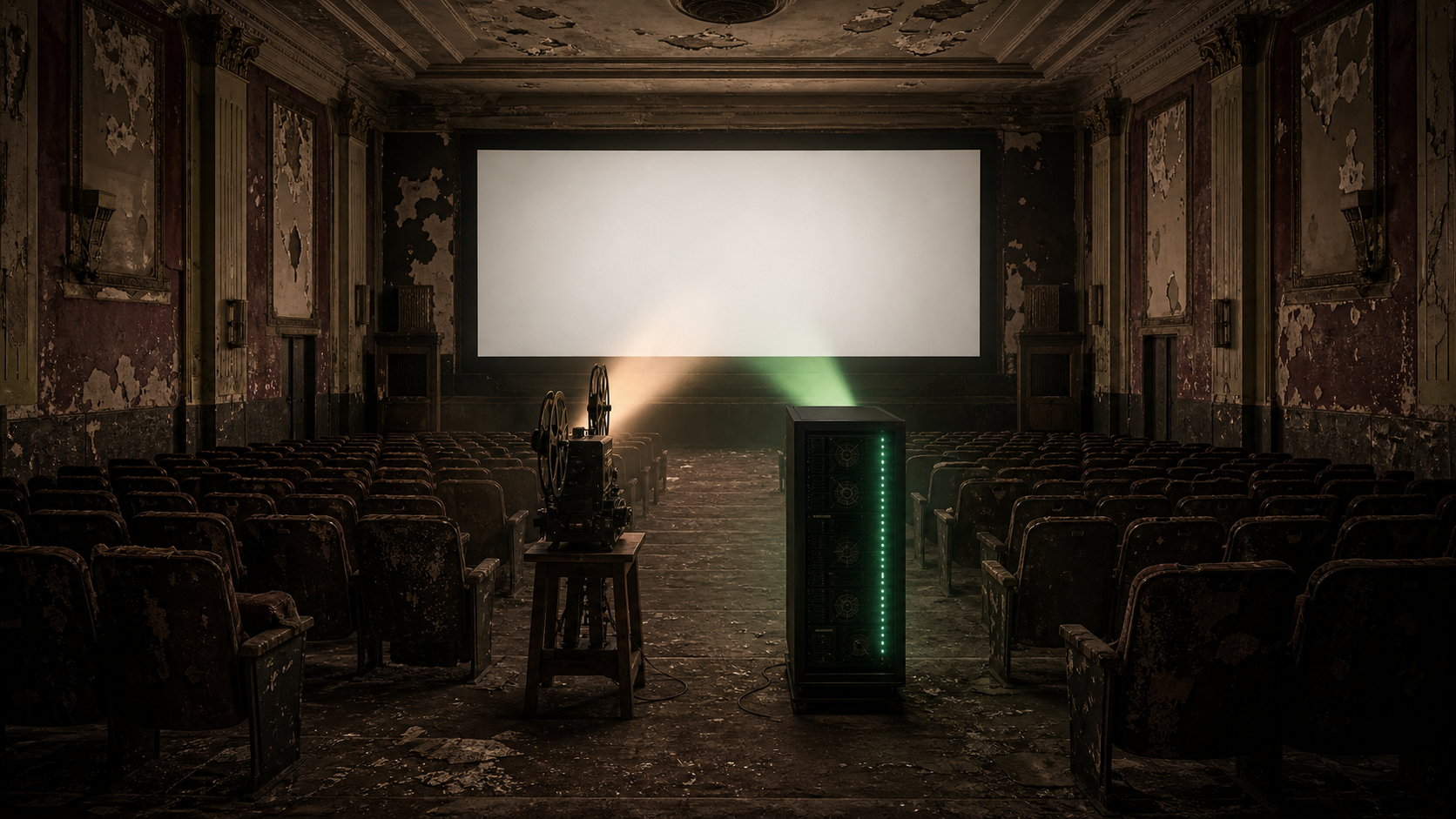
The apparatus changed. The job did not.
Read the numbers again with that in mind. 16,181 generations down to 253 shots is not a story about a machine making a film. It is a story about fifteen people pulling a lever sixteen thousand times and keeping the good ones, which is not authorship, it is curation, and curation at that ratio is closer to panning for gold than to writing.
The Lumière brothers filmed a train arriving at a station and people are supposed to have fled the room. That film is also not very good. Nobody watches it for the story. The comparison flatters Hell Grind and it is still the right one: the first demonstration of a medium is a demonstration, not a work. What made cinema was the thirty years afterwards, when people who understood people got hold of the apparatus.
So that is the thing to watch for. Not the next AI film from an AI company. The first one made by somebody who can actually write.
What this means if you run a normal business
The transferable lesson has nothing to do with film, and it is the most reliably misread thing about this entire wave.
Generative tools collapse the cost of making the thing. They do not touch the cost of knowing what is worth making. Every business currently getting a disappointing result out of AI has made the same mistake in a smaller way: they automated the production of the output and left the judgement unstaffed, and now they have forty blog posts nobody reads, or a chatbot that answers beautifully in the wrong direction, or a hundred variants of an advert that was never worth running once.
The ratio is the thing to internalise. One and a half per cent of what the machine produced was usable, and it took fifteen skilled people two weeks to find it. If your plan is "the AI will do it", you have budgeted for the generations and not for the sorting, and the sorting is where the work went. It did not disappear. It moved, and it moved towards taste, which is the one input that has not got any cheaper.
Use the tools. They are astonishing and they will save you a fortune on production. Then put your best judgement on the output rather than the input, and be extremely honest with yourself about whether anybody in the building is qualified to say "no, that one is bad" sixteen thousand times in a fortnight.
We build this kind of thing for clients, and the reason we are useful is almost never the generating. It is the part immediately after, where somebody has to decide.
Revolutionary, unprecedented, and dreadful. All three at once, which is what the beginning of something always looks like from the inside.